The C++ courses are presented by Frank B. Brokken.
 |
Frank started teaching C++ back in the early 90s of the previous century, shortly after the language became available in various compilers. He not only taught the language to thousands of students, but also designed, developed, implemented, and maintains about 20 large software projects, (cf. this link). Most of these projects are also available as Debian Linux software packages.
There's more to
If you're interested in learning |
General Information about the C++ course
The full C++ course consists of three parts. When using one meeting per week then each part takes about 9 to 10 weeks. Occasionally an extra (optional) meeting is injected.You can always join the course at any point, but when joining it is assumed that your level of knowledge already covers the topics of the preceding meetings.
Details about the courses
Follow this link for details about the courses.This is not a course about the C programming language

No, it's not. But as C is an almost complete subset of C++ The course covers almost all aspects of C as well. However, the main focus is on C++, but it's not just about churning out C++ code, but its very much also about understanding what and why you're doing, and also to design your software in such a way that --even after years-- you (or anybody else) are still able to understand what you did a long time ago. If this appeals to you, feel welcome to join the cours!
Also note this:
C++ after (or before...) Python?
 |
 |
Maybe you've already learned Python, which today is a very popular initial programming language. Or maybe you're wondering what programming language to learn: C++ or Python... What to do?
Here are some things you might want to consider:
- C++ is not a language built by a single or by a few developers. Instead it's built on an internationally accepted and developed standard. As a result: stability, well considered and documented modifications, and not very sensitive to fashion-ruled sudden decisions.
- C++ is not an outdated language. There are always pros and cons. What is important for you? Performance or just quick software development? If that distinction is important to you then have a look at this link.
- The types of programs for which C++ is used fit in categories like these: system software, game development, embedded systems, scientific computing and high-performance applications. See, e.g., this link or this link.
- And here's another nice little utube movie about C++: The untold story of C++


Do you recognize yourself in this?
Then the C++ course is ready to welcome you!
Can ordinary mortals complete this course?
Well, it depends. I call it a

In the past I noticed that some participants were somewhat annoyed because Google and/or ChatGPT couldn't provide them with the answers to the exercises. And yes, this course requires quite a bit of effort on your (and my) part, but then, when you've eventually completed my C++ courses you can truthfully state:
Yes, I've mastered C++!

Lots of attention is devoted to the c++26 standard, including template concepts, modules, and new additions to C++'s grammar.
On average, if you want tocomplete the course at a fairly high final grade, then be forewarned that in that case you should plan to invest about 15 hours each week. If that's too much for you to invest, the course can also be organized at a lower speed.
Background Theory
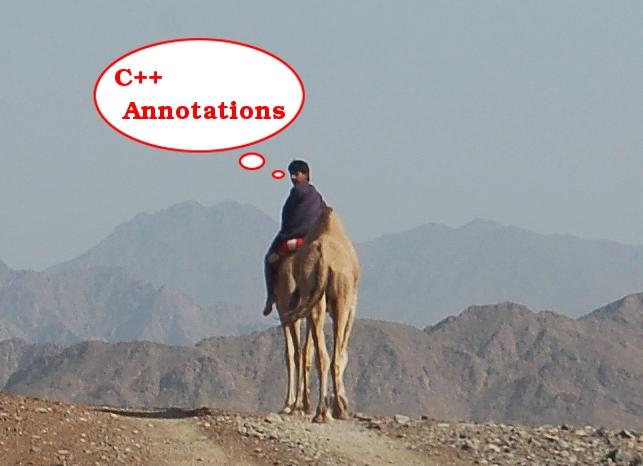
There are many books about C++. In this course we use the C++ Annotations which is available free of charge in various formats (e.g., html, pdf).
Frank B. Brokken
(frank@oosix.mx10.nl)
26 June 2026